South Carolina offers legal career opportunities in state government, manufacturing, healthcare, real estate, tourism, maritime commerce and business development. Columbia is the center of state government and appellate practice, while Charleston provides access to a growing commercial market, coastal development projects and international trade.
South Carolina has only two operating ABA-approved law schools in 2026. This article covers both in-state institutions, followed by three respected regional alternatives in North Carolina. The final three schools are not located in South Carolina and are identified accordingly.
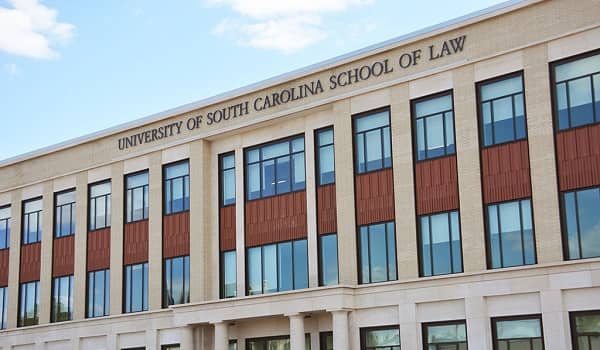
1. University of South Carolina Joseph F. Rice School of Law
- Location: Columbia, South Carolina
- Accreditation: American Bar Association
The University of South Carolina Joseph F. Rice School of Law is the state’s flagship public law school. Its Columbia location places students near the South Carolina Supreme Court, General Assembly, state agencies, law firms and numerous nonprofit organizations.
Students can explore business law, environmental law, healthcare, children’s law, criminal justice, taxation, technology and litigation. The school’s connections throughout South Carolina make it particularly valuable for candidates who intend to practise in the state after graduation.
Clinical opportunities include criminal defense, domestic violence, education rights, federal litigation, tax, veterans’ law, youth defense and a medical-legal partnership addressing children’s health. Students can also gain experience through externships, capstone courses and pro bono projects. South Carolina residents should examine its public-school tuition when comparing overall value.
2. Charleston School of Law
- Location: Charleston, South Carolina
- Accreditation: American Bar Association
Charleston School of Law offers a smaller, practice-focused legal education in one of South Carolina’s fastest-growing metropolitan areas. Students benefit from direct access to faculty members and professional connections with courts, law firms, businesses and public-interest organizations in the Charleston region.
The curriculum supports interests in litigation, criminal law, family law, business, real estate, maritime law and public service. Charleston’s port, tourism economy and continuing commercial development can provide useful professional exposure for students interested in maritime trade, property or business-related practice.
Experiential opportunities include externships, advocacy competitions and clinics involving housing, family law, domestic violence, mediation, parole, prosecution and community legal education. The school maintains a strong emphasis on pro bono service and helping underserved residents.
3. Duke University School of Law – Regional Option
- Location: Durham, North Carolina
- Accreditation: American Bar Association
Duke Law is not located in South Carolina, but it is a highly regarded regional alternative with national and international career reach. Its graduates enter major law firms, judicial clerkships, government, corporations, academia and public-interest organizations throughout the United States.
The school offers considerable depth in business and finance, technology, intellectual property, environmental law, constitutional law, international law and public policy. Duke students can also pursue interdisciplinary study through the university’s business, public policy, environmental and medical programs.
Duke’s experiential program includes 12 clinical courses and an extensive externship system. Students can work on civil justice, environmental law, community enterprise, children’s law, First Amendment issues, wrongful convictions, international human rights, Start-Up Ventures and health justice matters. Admission is exceptionally competitive, and the total cost of attendance should be considered carefully.
4. University of North Carolina School of Law – Regional Option
- Location: Chapel Hill, North Carolina
- Accreditation: American Bar Association
UNC School of Law provides a respected public legal education with strong connections across North Carolina and the Southeast. It can be especially attractive to students seeking careers in government, regional law firms, banking, business or public-interest practice.
Academic opportunities include banking and finance, intellectual property, entrepreneurship, constitutional law, civil rights, media law and public service. Students also benefit from access to the broader resources of the University of North Carolina at Chapel Hill.
UNC’s clinics cover civil litigation, economic justice, immigration, family defense, intellectual property, military and veterans’ law, community development and startup businesses. Its location within the Research Triangle creates additional opportunities with technology companies, healthcare organizations, startups and research institutions.
5. Wake Forest University School of Law – Regional Option
- Location: Winston-Salem, North Carolina
- Accreditation: American Bar Association
Wake Forest Law offers a close academic community with an emphasis on professional development, practical ability and faculty engagement. Its graduates work throughout North Carolina, South Carolina and other regional and national markets.
Students can study business law, litigation, intellectual property, environmental law, healthcare, criminal justice and leadership. The school’s comparatively personal environment may suit applicants who prefer smaller classes and regular interaction with professors.
Practical training is available through clinics, externships, trial practice and semester-long professional placements. Current clinical areas include intellectual property, medical-legal partnerships, environmental law, veterans’ advocacy, appellate work and innocence-related representation. These opportunities help students develop client counseling, drafting, advocacy and case-management skills.
Factors Considered for This Selection
The institutions were evaluated using the following considerations:
- ABA accreditation and availability of a recognized J.D. program
- Academic quality and professional reputation
- Access to South Carolina and Southeastern legal markets
- Clinics, externships and other practical experiences
- Faculty expertise and available areas of specialization
- Connections with courts, law firms, companies and government agencies
- Alumni networks and geographic career reach
- Tuition, scholarships and total cost of attendance
- Bar preparation and publicly reported graduate outcomes
Conclusion
The University of South Carolina Joseph F. Rice School of Law offers the state’s strongest combination of public-school value, alumni connections and access to government and legal employers. Charleston School of Law provides a smaller, practice-oriented environment with valuable opportunities in the growing Charleston market.
Because South Carolina contains only two ABA-approved law schools, Duke, UNC and Wake Forest have been included as regional alternatives. Duke provides the broadest national reach, UNC combines public-school value with a strong Southeastern network, and Wake Forest offers personalized instruction and substantial practical training.
Applicants should compare scholarship conditions, total borrowing, bar-passage results and employment disclosures before enrolling. Those planning to practise in South Carolina should also consider whether each school provides sufficient opportunities to develop relationships with the state’s courts, firms and legal community.