No — lane splitting is illegal in New York. State law explicitly prohibits motorcyclists from riding between lanes of traffic, regardless of speed, road conditions, or how congested traffic may be. This applies everywhere in the state, including New York City.
What Is Lane Splitting?
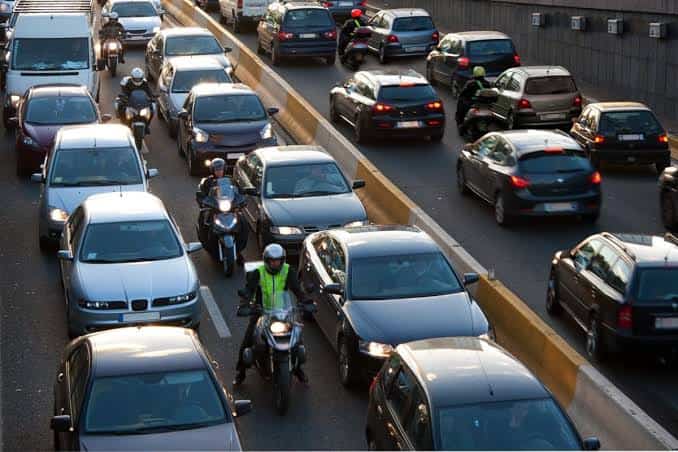
Lane splitting is when a motorcyclist rides between two lanes of traffic moving in the same direction — typically to pass slower or stopped vehicles. It’s distinct from two related practices that are also illegal in New York:
- Lane filtering — moving between stopped or near-stopped vehicles, such as at a red light
- Lane sharing — two motorcycles riding side by side in the same lane, which is actually legal in New York for up to two motorcycles abreast
All three terms are often confused. To be clear: only lane sharing (two bikes, same lane, side by side) is permitted under New York law. Lane splitting and lane filtering are both banned.
What Does the Law Say?
New York’s prohibition is codified in Vehicle and Traffic Law § 1252, which prohibits motorcyclists from operating a motorcycle between lanes of traffic or between adjacent lines or rows of vehicles, and from overtaking and passing in the same lane occupied by the vehicle being overtaken.
The only exception is for police officers performing official duties. There are no civilian exceptions.
What Are the Penalties?
Motorcyclists caught lane splitting can face fines of up to $150 and up to two points added to their driving record. Accumulating too many points can result in license suspension, and insurers may raise premiums or cancel policies for riders with traffic violations.
In more serious cases — particularly if an accident results — a rider could also face civil liability and significant complications with any injury claim.
How Does It Affect an Accident Claim?
This is where the consequences extend well beyond a simple traffic ticket. New York follows a pure comparative negligence rule, which means compensation in an accident can be reduced in proportion to the rider’s share of fault. If a motorcyclist is found to be 30% at fault because they were lane splitting when a crash occurred, their total compensation is reduced by 30%.
Insurance companies routinely use illegal lane splitting to argue partial fault against injured riders — even in cases where another driver clearly caused the collision. It hands the insurer a ready-made argument, and riders often receive less than they deserve as a result.
Is New York the Only State That Bans It?
No, but it is in the minority. As of 2025, California is the only state where lane splitting in moving traffic is explicitly legal. Several states allow lane filtering between stopped vehicles — Utah, Montana, Arizona, and Colorado — each with specific speed and condition restrictions. Most other states, including New York, Texas, Virginia, and Illinois, prohibit both practices entirely.
Could the Law Change?
Possibly, but not soon. Bills have been introduced in the New York State Legislature to allow lane splitting or filtering, but none have passed. The ban remains fully in effect, and there is no indication of imminent change in Albany.
What Can Motorcyclists Do Instead?
Since lane splitting is off the table, legal alternatives for navigating New York traffic include:
- Choosing travel times wisely — avoiding peak congestion hours where possible
- Using HOV lanes — motorcycles are generally permitted in High Occupancy Vehicle lanes, which often move faster in heavy traffic
- Lane positioning — staying toward the front of a lane at stops improves visibility and reduces rear-end risk
- Planning alternate routes — many GPS apps offer motorcycle-specific routing that avoids the worst bottlenecks
Frequently Asked Questions
Q1. Is lane filtering legal in New York (moving between stopped cars at a red light)?
No. Lane filtering is also prohibited under VTL § 1252, the same law that bans lane splitting. Both are illegal regardless of traffic speed or conditions.
Q2. Can two motorcycles ride side by side in New York?
Yes. Two motorcycles may ride abreast in a single lane. More than two abreast is illegal.
Q3. Does lane splitting affect my insurance?
Yes. A lane-splitting citation can lead to higher premiums or policy cancellation. If you are involved in an accident while lane splitting, insurers will use it to argue partial fault against you.
Q4. Is lane splitting legal in New York City specifically?
No. NYC follows New York State law, and lane splitting is prohibited throughout all five boroughs.
Q5. Are there any exceptions for motorcyclists?
The only exception under VTL § 1252 is for law enforcement officers on official duty. There are no exceptions for civilians, regardless of traffic conditions or emergency situations.